



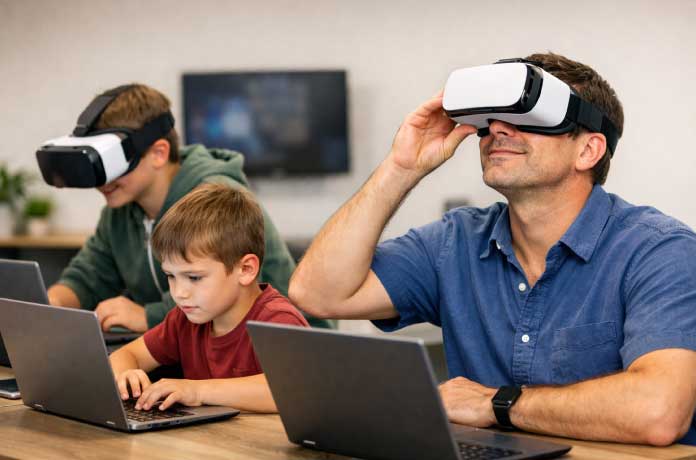
Virtual Reality (VR) has made significant inroads into education, unlocking new ways students learn and interact with educational content. Here are some crucial aspects of how VR is being used in education:
- Immersive Learning Experiences: VR provides a highly immersive environment where students can engage with content in ways that are impossible through traditional methods. This immersive quality can enhance understanding and retention of complex subjects.
- Virtual Field Trips: VR allows students to visit far-off places or historical sites without leaving the classroom. This can enhance the study of geography, history, and other subjects that benefit from real-world context.
- Interactive Simulations: VR can simulate complex processes or experiments that would be too expensive, dangerous, or logistically challenging to conduct in real life. For example, chemistry students can perform virtual experiments safely.
- Medical Training: VR is widely used in medical education to provide realistic surgical simulations, anatomy lessons, and patient diagnosis scenarios. Medical students can practice procedures and surgeries in a risk-free environment.
- Language Learning: VR can immerse language learners in a virtual environment where they can practice speaking and listening in real-life situations, improving language proficiency.
- STEM Education: VR is particularly valuable in science, technology, engineering, and mathematics (STEM) education. Students can manipulate 3D models, conduct virtual dissections, and engage in physics experiments.
- Special Education: VR can be tailored to meet the needs of students with disabilities. It can provide multisensory experiences, adapt to individual learning styles, and offer a more inclusive learning environment.
- Skill Development: VR is used to teach practical skills, such as flight training, architecture design, and car mechanics. Users can practice and enhance their skills in a safe and regulated setting.
- Collaborative Learning: VR enables collaborative learning experiences. Students from different locations can meet in a virtual classroom, collaborate on projects, and work together in shared virtual spaces.
- Engagement and Motivation: VR is inherently engaging, and this engagement can motivate students to explore and learn. It can make learning fun and engaging, reducing boredom and increasing participation.
- Data Visualization: Complex data sets and abstract concepts can be visualized in 3D environments, making it easier for students to grasp and analyze them.
- Soft Skills Training: VR is used for training soft skills like leadership, communication, and teamwork. Simulated scenarios challenge students to apply these skills in realistic situations.
- Historical Reenactments: History classes can benefit from VR by reenacting historical events or exploring ancient civilizations, making history more tangible and engaging.
- Career Exploration: VR can provide a realistic preview of various careers, helping students make more informed choices about their future.
- Adaptive Learning: VR systems can adapt content and difficulty levels based on a student’s progress and performance, offering a personalized learning experience.
While VR in education offers many advantages, it also comes with challenges, such as the cost of VR equipment, technical limitations, and the need for quality content development. As technology advances and becomes more accessible, VR plays an increasingly significant role in education, offering new and innovative ways for students to learn and engage with educational material.