


In the ever-evolving landscape of agriculture, technology integration has become paramount to addressing the challenges of feeding a growing global population while mitigating environmental impacts. Smart farming, also known as precision agriculture, encompasses a myriad of technologies and techniques aimed at optimizing efficiency, sustainability, and productivity in farming practices. From drones to data analytics, smart farming is revolutionizing agriculture in profound ways.
Precision Farming:
Precision farming involves advanced technologies to manage and optimize crop production. This involves using real-time data and analysis to precisely apply pesticides, fertilizers, and water. By employing sensors, GPS technology, and automated machinery, farmers can tailor inputs to the specific needs of their crops, minimizing waste and maximizing yields. Precision farming not only improves resource efficiency but also enhances crop quality and reduces environmental impact.
IoT and Sensor Technology:
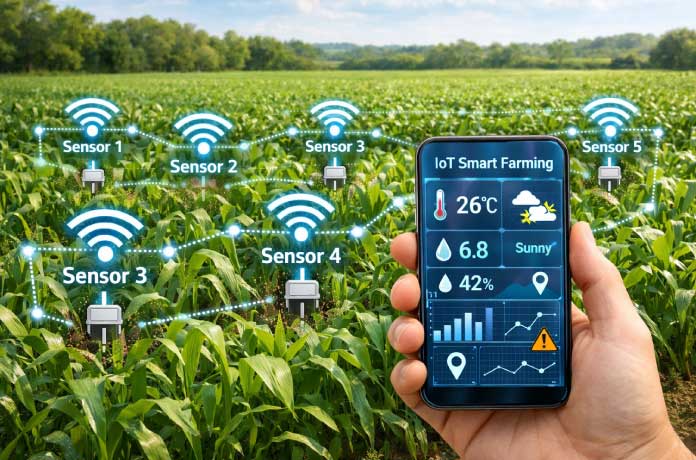
The Internet of Things (IoT) has permeated various sectors, and agriculture is no exception. IoT devices and sensor technology enable farmers to collect and monitor data on soil moisture levels, temperature, humidity, crop health, and more. This real-time data provides invaluable insights into crop conditions, allowing farmers to make data-driven decisions regarding irrigation, fertilization, and pest management. By leveraging IoT devices, farmers can optimize resource allocation, reduce risks, and increase yields.
Remote Sensing and Drones:
Remote sensing technologies, including satellites and drones, offer farmers a bird’s-eye view of their fields. These technologies provide high-resolution imagery and data on crop health, growth patterns, and pest infestations. By analyzing this data, farmers can detect problems early, identify areas of concern, and take proactive measures to address issues such as nutrient deficiencies or disease outbreaks. Drones, in particular, offer agility and flexibility in monitoring large agricultural areas efficiently, making them indispensable tools for modern farmers.
Data Analytics and Machine Learning:
The abundance of data generated by smart farming technologies necessitates advanced analytics for meaningful insights. Machine learning algorithms can analyze vast datasets to identify patterns, predict outcomes, and optimize farming practices. By harnessing historical data on weather patterns, soil conditions, crop performance, and market trends, farmers can make informed decisions to improve productivity and profitability. Data analytics also facilitate precision agriculture by enabling farmers to fine-tune their strategies based on real-time feedback and predictive modeling.
Vertical Farming and Controlled Environment Agriculture:
As urbanization accelerates and arable land becomes scarce, innovative farming techniques such as vertical farming and controlled environment agriculture (CEA) are gaining traction. Vertical farming involves cultivating crops in vertically stacked layers, often in controlled indoor environments using hydroponic or aeroponic systems. CEA utilizes technologies like LED lighting, climate control, and nutrient delivery systems to create optimal growing conditions year-round. These methods minimize land usage, conserve water, and reduce dependency on pesticides while maximizing yields in urban settings.
Autonomous Machinery and Robotics:
Automation is revolutionizing traditional farming practices, reducing labor costs and increasing efficiency. Autonomous tractors, harvesters, and drones equipped with AI and GPS technology can perform tasks such as planting, spraying, and harvesting with precision and accuracy. Robotics are also used for tasks like weeding and fruit picking, alleviating the need for manual labor and addressing labor shortages in agriculture. By automating repetitive tasks, farmers can focus on higher-value activities and achieve greater operational efficiency.
Smart farming technologies and techniques are reshaping the agricultural landscape, offering unprecedented opportunities to enhance productivity, sustainability, and profitability. By leveraging IoT, data analytics, remote sensing, and automation, farmers can optimize resource utilization, minimize environmental impact, and meet the growing demand for food in a rapidly changing world. Embracing these innovations is essential for the future of agriculture, ensuring food security, environmental stewardship, and economic prosperity for generations to come.